03.01.2026

The activities and program implementation of the "Armenian Genocide Museum-Institute" (AGMI) Foundation continued in the following directions:
Research and Publishing Activities
During 2025, AGMI staff conducted research dedicated to the history of the Armenian Genocide, the study of the life, demographics, and education of Armenians living throughout the Ottoman Empire in the pre-genocide era, micro-histories of genocide survivors, and the methods and manifestations of the genocide's implementation in specific geographical areas. Research also covered memoirs, the Turkish press, current threats of genocide implementation, and the history of genocides of other groups. Special attention was also paid to the study of the legal aspects of genocides.
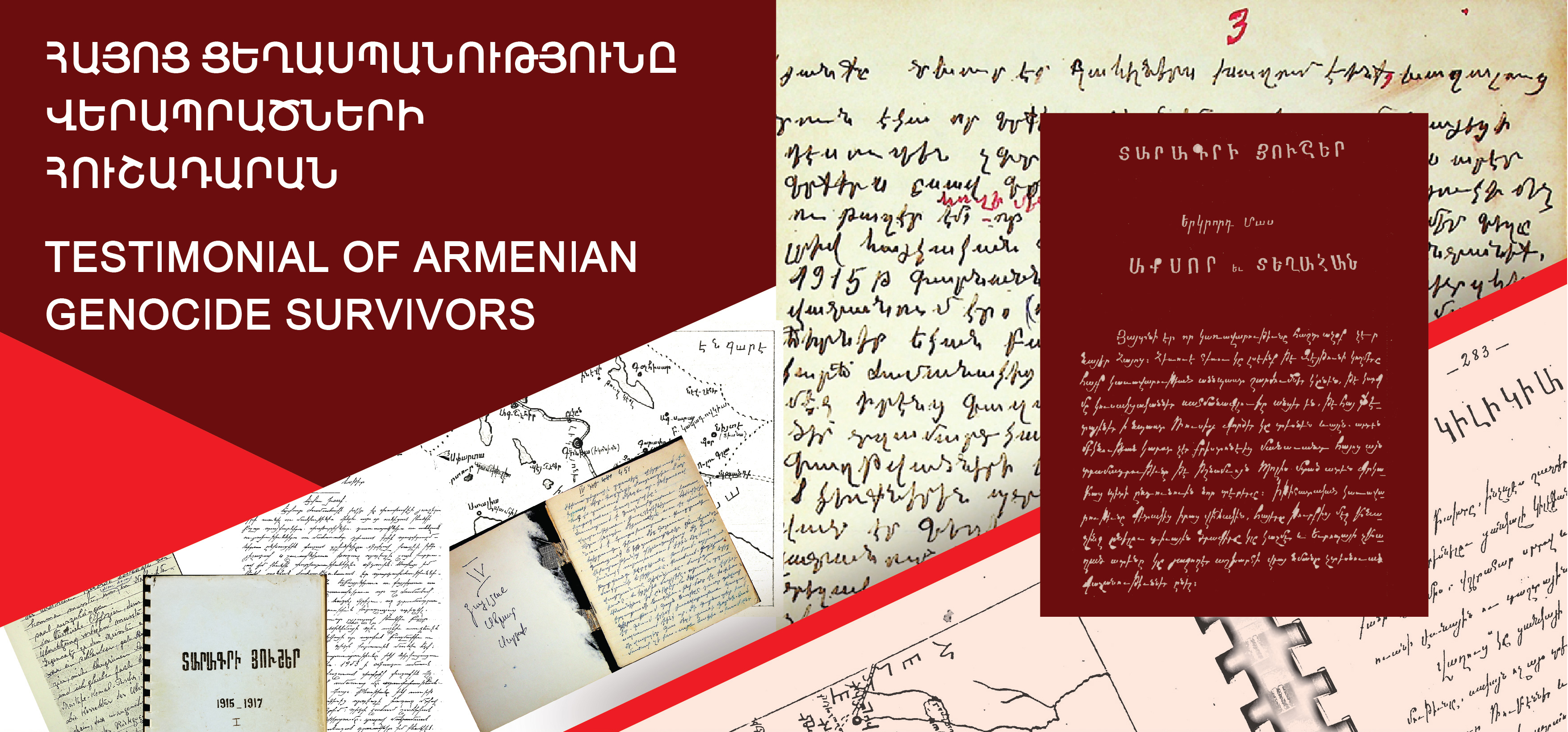
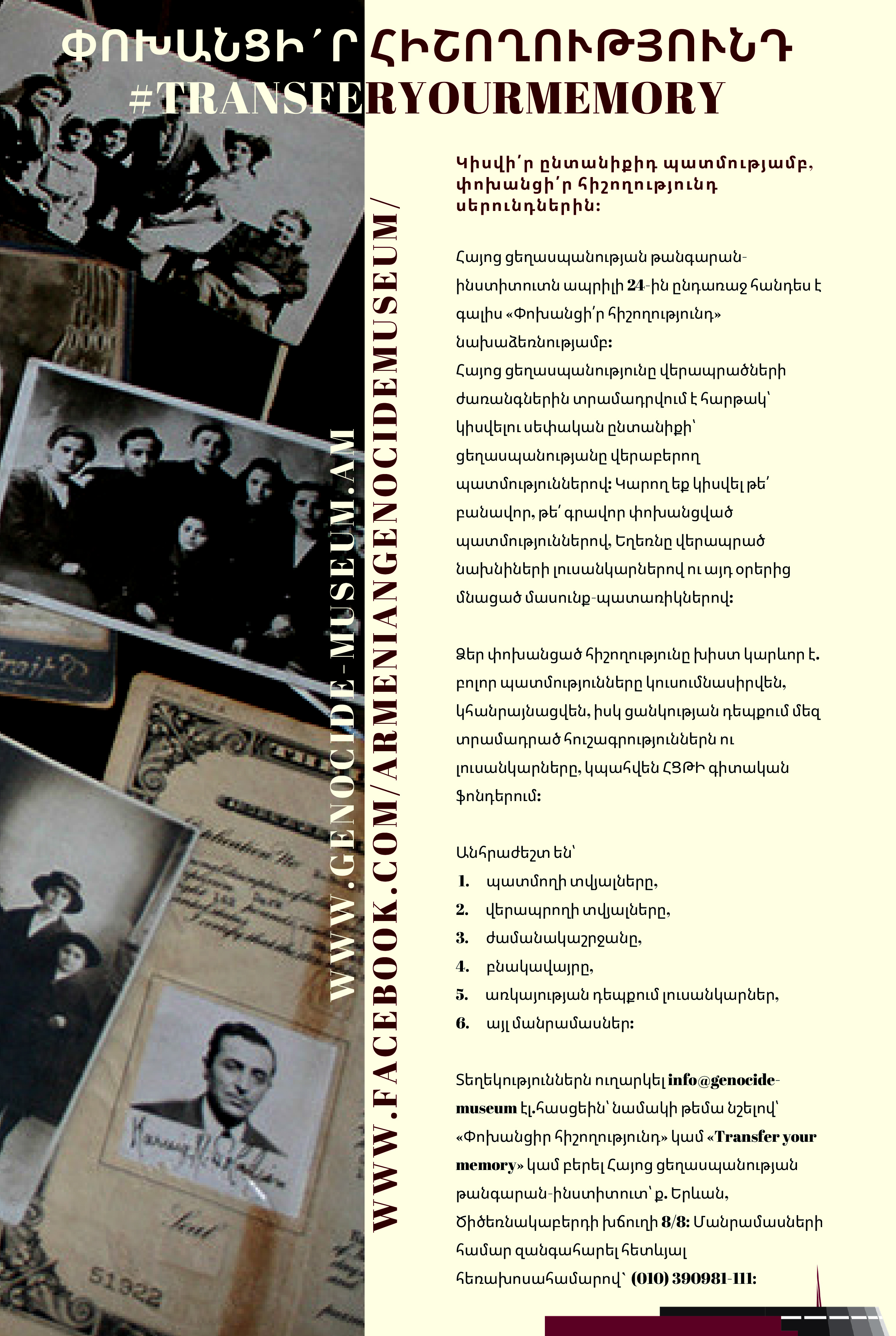
Documentation and Study of Armenian Genocide Victims and Survivors The collection of oral histories was carried out through working visits and field data collection. The collection of data, audio materials, and video materials regarding victims and survivors of the Great Crime (Meds Yeghern) continued. Thematic scientific studies in the fields of memory, oral history collection, and documentation continued, presenting pan-Armenian experiences as well as AGMI’s activities in this direction from its origins to the present stage.
Study of Repressions against Armenians of Artsakh, Nakhichevan, and Azerbaijan Within this framework, work continued on the manifestations of discrimination against Armenians in Soviet Azerbaijan, specific episodes of the Artsakh movement, the cultural genocide currently being perpetrated by Azerbaijan, the forced displacement of the Armenians of Artsakh, and the policy of isolation conducted against Armenians in the Nakhichevan Autonomous Soviet Socialist Republic during the 1920s-1980s.
Comparative Genocide Studies Research was conducted on current threats of genocide implementation and manifestations of resistance by Armenian women; parallel to this, the activities of female Turkish perpetrators were also studied.
In connection with the 110th anniversary of the Armenian Genocide and the 80th anniversary of the Holocaust, seminar-discussions were organized dedicated to resistance during genocides, as well as events dedicated to the memory of the victims of the Greek Genocide.
Source Studies of the Armenian Genocide Thematic research was conducted, and unpublished reports and memoirs were examined. The 14th volume of the "Memoirs of Armenian Genocide Survivors" series was published. Final editing work on two more memoirs is in progress. Special attention was paid to the origins of the missionary movement in the Ottoman Empire, the study of policies implemented against Armenians during the Hamidian period, the number of victims during the Armenian Genocide years, orphan care activities, and processes of preserving Armenian identity in orphanages.
Legal Studies of the Armenian Genocide Studies on legal issues related to the Armenian Genocide and Artsakh continue. Special attention was paid to the concept of "attempted genocide," which has long been overlooked under international law, providing legal assessments of the massacres of Armenians that took place in Sumgait, Kirovabad (Gandzak), and Baku in 1988-1990.
The scientific results of staff studies were presented to the public through articles, publications, scientific reports, temporary exhibitions, public lectures, round-table discussions, and educational programs.
One of the significant scientific achievements for the Armenian Genocide Museum-Institute and the field of Armenian Genocide studies in general was the inclusion of the International Journal of Armenian Genocide Studies in the Scopus international scientific database. This serves as an assessment of the international value of Armenian Genocide research and the contribution of AGMI staff to this field.
Two regular issues of the Journal of Genocide Studies (Armenian) and the International Journal of Armenian Genocide Studies were published.
During 2025, the researchers, with a small team, were able to secure significant results in the scientific field and record important progress.
Publications by Staff:
a) For the first time in AGMI's 30-year history:
One monograph included in the Scopus database:
Harutyun Marutyan, Commemorating the Armenian Genocide (London, New York, Oxford: I.B. Tauris, 2025)
https://www.bloomsbury.com/us/commemorating-the-armenian-genocide-9780755657230/ (I.B. Tauris և Bloomsbury Press)
One edited volume:
The Silenced Crime: Forcible Child Transfer During the Armenian Genocide, edited by Edita Gzoyan (Brill, 2025).
https://brill.com/display/title/71069. Containing 7 articles by AGMI researchers.
b) 14 articles in Scopus and WOS international scientific databases:
WOS, Scopus Q1 - 4 articles
WOS, Scopus Q2 - 2 articles
WOS, Scopus Q3 - 1 article
Scopus Q1 - 1 article
Scopus Q2 - 2 article
Scopus IJAGS - 4 articles
c) 5 chapters in English-language edited volumes.
d) One scientific monograph: Harutyun Marutyan, Commemorating the Armenian Genocide [Armenian edition], Yerevan, AGMI, 2025, 408 pages, 160 photos.
e) 21 scientific articles in Armenian and foreign journals.
f) Three memoirs:
1. Atanasian Harutyun G., From Adabazar to Der Zor. Editor, author of preface and annotations: Mihran A. Minasian, Yerevan, AGMI, 2025, 568 pages.
2. The Newly Discovered Shatakh: Memoir of a Shatakh Native Who Survived the Armenian Genocide. Editor, author of preface and annotations: Elina Mirzoyan, AGMI, 2025, 344 pages, "Memoirs of Armenian Genocide Survivors," Vol. 14.
3. Bodil Biørn, Memoirs of an Eyewitness: The Legacy of Bodil Katherine Biørn, edited by Regina Galustyan, Yerevan: AGMI, 2025, 370 pages.
g) Translations of the Armenian Genocide Museum Guidebook into Russian, French, German, Chinese, and Italian.
h) Two works edited by staff members (preface or scientific article).
i) Three other works:
Raymond H. Kévorkian, El Genocidio de los Armenios y sus Consecuencias, Fundación del Museo-Instituto del Genocidio de los Armenios, Ereván, 2025, 48 páginas.
Raymond H. Kevorkian. Il genocidio armeno e le sue conseguenze, Fondazione Istituto-Museo del Genocidio Armeno, Jerevan, 2024, 48 pagine.
Birgit Kofler-Betshart, I Killed a Man, But I Am Not a Murderer: The Armenian Genocide, the Revenge of the Victims and the Secret Operation "Nemesis". Responsible for Armenian translation and editor: Hayk Martirosyan, Translator: Ashot Hayruni, Yerevan, AGMI, 2025, 228 pages.
Researchers presented 45 reports within the framework of various conferences, 40 of which were at international conferences.
International Conferences Organized by AGMI:
1. "From Young Turk Nationalism to Nazism: Armenian Genocide Survivors on the Frontlines of the Resistance Movement," international conference, March 15-16. Within the framework of "Manouchian Week," co-organizer: AGMI Foundation.
2. "A Century of Armenian Genocide Studies: Legacy, Challenges, and Future," international conference, May 29-31, organizer: AGMI Foundation.
3. Professional workshop entitled "Armenia and the International Criminal Court (ICC): One Year of Membership," February 1, organizer: AGMI Foundation.
4. AGMI organized a Moot Court Competition on the Crime of Genocide for the first time in Armenia (June 21-22).
5. Within the framework of the agreement signed between AGMI and Lepsiushaus Potsdam, four researchers participated in "The Armenian Genocide: 110 Years After" international conference, Lepsiushaus Potsdam, November 8-9.
6. AGMI organized various scientific events, seminar-discussions, etc., and AGMI researchers participated in various professional discussions and other events organized in Armenia and abroad.
a) 18 lectures by AGMI staff.
b) 9 lectures by foreign and other Armenian specialists.
c) Summer schools: 2 (organized by AGMI), plus 2 with the participation of AGMI staff.
d) Commemorative events: 7.
e) Book and film discussions: 4.
f) Book presentations: 6.
g) Summaries and award ceremonies of school competitions: 2.
h) Meetings/discussions with foreign students and journalists: 3.
i) Workshops/discussions with the participation of AGMI researchers: 5.
AGMI Foundation Activities in 2025 by Direction:
Exhibition Activities:
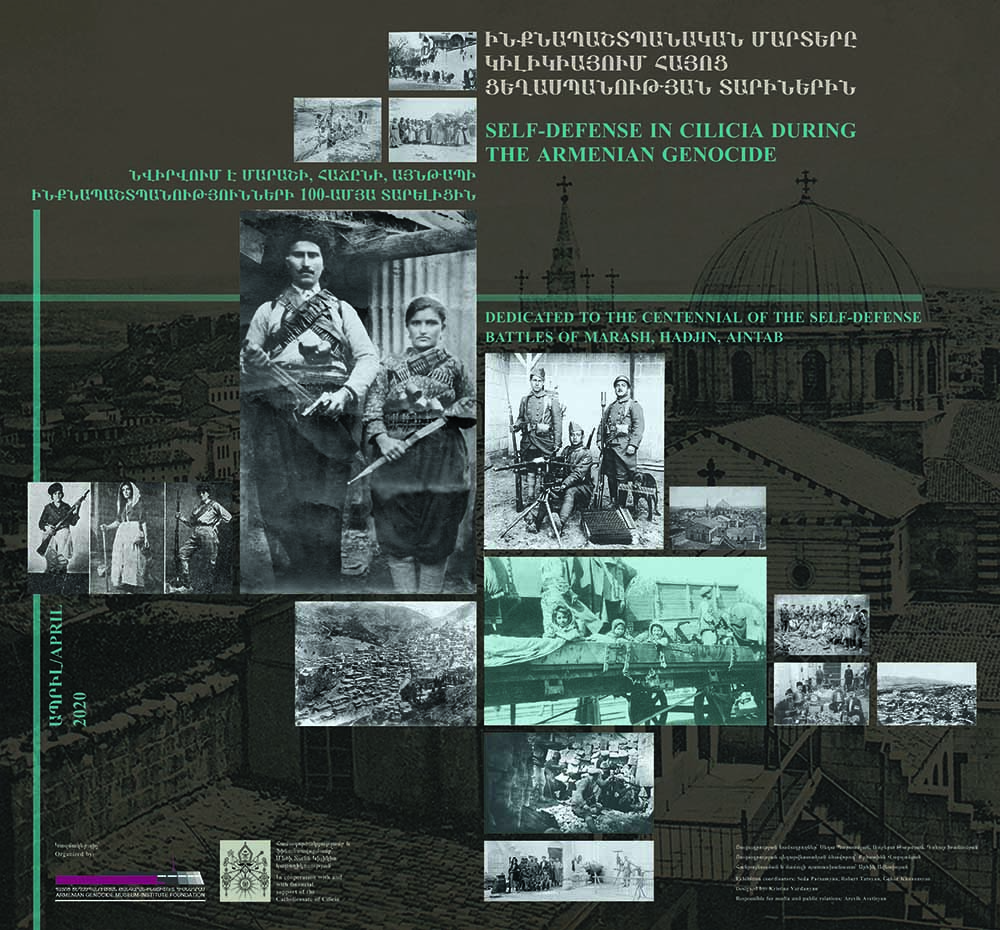
1. Within the framework of the 110th anniversary of the Armenian Genocide, a temporary exhibition titled "Documenting the Crime: Eyewitness Documenters of the Armenian Genocide" was organized. It was presented in a space twice as large as previous exhibitions with new scientific and artistic solutions. The exhibition presented the world's response to the Armenian Genocide at the level of both state governments and individuals. It will be open until April 2026.
During 2025, temporary and permanent exhibitions such as "Armenian Woman: Victim and Hero of the Genocide," "Documenting the Crime," "Tracing Armenian Schools: Certificates of an Educated Nation," and "Tracing the Families of Armenian Genocide Survivors" were displayed at Haigazian University in Beirut (Jan 30), Arizona State University (April 1-3), Oxford University (April 23), Bucharest (April 11), Glendale (April 21), Chisinau (April 23), Moscow (April 23), St. Petersburg (April 24), Krasnodar (April 24), Cagliari (May 3), as well as in the cities of Abovyan (April 29) and Gyumri (April 30).
Preparatory work is underway with the Komitas Museum-Institute to organize a temporary exhibition on "Armenian Intelligentsia during the Years of the Armenian Genocide."
Scientific-Educational Activities:
The organization of lectures for students of various Armenian and foreign educational institutions continued.
1. Within the framework of the "Teaching the Topic of the Armenian Genocide" educational program, the program for middle and high school students continued in 2025. AGMI researchers delivered 34 lectures for 752 students (522 from Yerevan and 230 from regions) in 27 educational institutions (16 in Yerevan and 11 in regions).
2. The essay contest announced for high school students in Armenia and Uruguay dedicated to the 110th anniversary of the Armenian Genocide was summarized. The first-place students from Armenia and Uruguay, along with their mentor teachers, will travel to the USA, where, in cooperation with "The Genocide Education Project," they will present their essays in various US schools and participate in educational and cultural events. Co-organizers: AGMI, National Administration of Public Education of Uruguay, AGBU Uruguay Chapter.
3. Work was carried out on organizing the scientific work of current PhD students and applicants. In the current year, 2 people were admitted to the AGMI postgraduate program.
4. The fourth training program for American teachers was organized jointly by "The Genocide Education Project" (GenEd) and AGMI (July 11-20).
5. The VII Summer Two-Day School for Armenian teachers on "Teaching the Topic of the Armenian Genocide" was organized, attended by about three dozen teachers from Yerevan and various regions. Specialists in genocide studies and related fields from AGMI and other educational institutions presented about fifteen lectures to the teachers (July 22-23).
6. David Hackett (Ph.D. student at Columbia University), winner of the Raphael Lemkin Scholarship, will conduct his research at AGMI in January 2026.
7. AGMI initiated the compilation of a textbook for the course "Issues of the Armenian Genocide" (compiled by AGMI and guaranteed by the Ministry of Education, Science, Culture and Sports).
Acquisition of Scientific Archives and Exchange of Experience:
a) Work was carried out in the library and archives of Haigazian University in Beirut and the Matenadaran of the Catholicosate of the Great House of Cilicia.
b) Work was carried out in other thematic archives.
c) Collection work in Armenian archives continues; selection and sorting of thematic documents are being carried out, and work is being done to scan them.
d) Archival materials were acquired from the Save the Children Fund archives (UK).
e) Father Vahan Ohanian, a member of the Mekhitarist Congregation in Venice, donated his archive collected as a result of his activities—32,000 documents—to the AGMI Foundation.
f) Vahram Shemmassian (Lecturer at California State University) donated some materials from his personal archive formed as a result of his long-term scientific and collecting activities to the AGMI Foundation.
g) Primary source materials regarding the Hamidian massacres and the Armenian Genocide were acquired from the Central State Archives of Sofia.
h) A large amount of thematic material was acquired from the US Library of Congress.
Museum Activities:
a) 52 official delegations visited the Memorial and Museum; 5 silver firs were planted in the Memory Alley.
b) As of December 30, the museum had 89,368 visitors, of which 75,158 were foreign and 14,210 were local. 14,448 visitors toured the exhibition with a guide, of which 4,776 were served free of charge.
c) During the specified period, 8,432 pupils and students from educational institutions of the republic and the diaspora visited the museum.
d) During the year, the guides and researchers of the museum-institute conducted 1,445 excursions in Armenian, Russian, English, and French.
e) On April 23, the exhibition hall, which had been closed since June 21, 2021, for the safety of visitors and employees, was reopened after renovation work. The projector installed on the ramp was replaced with a new one.
f) New and modern audio guides and radio guides acquired within the framework of the grant provided by the Gishyan Foundation were launched in the museum.
g) 3,138 visitors toured the exhibition using audio guides. English, German, and Chinese versions were added to the existing French and Russian audio guides.
h) As a result of cooperation with the USC Shoah Foundation, the Armenian Genocide Memorial was included in the IWalk application.
Scientific Funds Activities:
During the reporting period, the AGMI museum fund received 162 items as donations, which will be distributed to the archive and the scientific auxiliary fund respectively.
Important acquisitions included:
a) Paintings "Lament-1915" by Minas Avetisyan and "Deportation of a Nation" by Grigor Zohrab Keshishian.
b) The personal archive of Toros Tadevosyan, a student of the Antoura orphanage, personal documents regarding Musa Dagh people, related materials, an original photo of Gevorg Chaush's wife, memoirs of Armenian Genocide survivors, personal documents, and photos.
AGMI curators participated in a three-day training course titled "Large-scale Conservation of Photographic Collections" organized by the Ministry of Education, Science, Culture and Sports and the National Heritage Institute of France.
Activities in the Scientific Library:
During the specified period, the AGMI scientific library was replenished with 1,154 library units acquired through donations and purchases. The library received 357 units of Turkish professional literature from Sargis Hatspanian's personal library via donation, and 65 books were transferred to the AGMI library by the Research on Armenian Architecture (RAA) Foundation.
The process of separating the Library from the Scientific Fund was completed, with items distributed among the relevant departments.
Digitization and Data Entry:
AGMI's temporary and traveling exhibitions received artistic design. AGMI publications and the German, Chinese, and Italian versions of the Armenian Genocide Museum Guidebook were processed and artistically designed. About 150 posters, book layouts, and book covers were designed.
Work continues on the complete digitization of AGMI museum funds—approximately 2,000 units. About 375 pages of unpublished memoirs were typed, and 10 library books and about 2,300 pages of periodical press were digitized.
Work continues on the complete digitization of photos in the funds, based on which the first issue of the thematic photo album series was compiled: "The Extermination of Armenians and Greeks of Smyrna and the Burning of Their Districts."
International and Local Cooperation:
a) A memorandum of cooperation was signed with the Embassy of Germany in Armenia for the German translation and launch of the museum's audio guide texts, and the German translation and publication of the museum exhibition guidebook.
b) There was cooperation with the Embassies of France and Italy in Armenia; within this framework, versions of the Armenian Genocide Museum guidebooks in the respective languages were printed.
c) Cooperation continued with the "Aniv" Foundation for the Development and Support of Armenian Studies, the Armenian Bar Association, and the Georgia branch of the Max Weber Foundation.
d) Negotiations are underway to sign a memorandum of cooperation with the Vienna Wiesenthal Institute for Holocaust Studies.
e) Negotiations are underway with the Camp des Milles Foundation (France) regarding the signing of a memorandum.
f) A memorandum of cooperation was signed with the Catholicosate of the Great House of Cilicia.
g) Negotiations are being held regarding the signing of a memorandum of cooperation with the "Renaissance" Foundation.
h) Within the framework of the cooperation agreement with V. Brusov State University, the translation of the museum's audio guide texts and catalog into Chinese and Korean was carried out.
Scientific Information and Awareness Activities:
a) The official website of the Foundation was updated on a daily basis; information about AGMI activities, various events, conferences, etc., was prepared, processed, and posted in 5 languages.
b) In the field of information and awareness, AGMI adopted a new policy based on the application of modern approaches and tools. Tangible results are already noticeable in terms of strengthening public relations, growth in the number of followers and views, and activation of public response.
During 2025, 179 publications were made on the site. 32 publications were made regarding all visits by students within the framework of the "Teaching the Topic of the Armenian Genocide" educational program. In total, 211 publications were also posted on the AGMI Facebook account.
During the reporting period, the AGMI website had 2,250,060 visits (compared to 2,915,858 in 2024).
During the specified period, the visibility of AGMI Facebook posts increased sharply, reaching 2,645,352 from the previous year's 363,793. The number of Facebook followers increased by 1,799, reaching 25,814. 102 posts were made on the Instagram account.
c) Final technical corrections and additions are being carried out for the launch of the new website.
Grants for Scientific Studies:
Research continues within the framework of SC (Science Committee) (7) and YS (Young Scientists) (2) grants.
Other grants: The "Stepan Gishyan" Charitable Foundation supported the technical re-equipment of the museum in 2025.
The Ministry of Foreign Affairs of Norway, through small grants from the Embassy of Georgia (concurrently accredited to Armenia) within the 2024-25 program, funded the translation from Norwegian to English and publication of the handwritten memoirs of Norwegian missionary and Armenian Genocide witness Bodil Katherine Biørn.
Maintenance of "Tsitsernakaberd" Park Territory:
This year, the improvement and maintenance of the "Tsitsernakaberd" park territory (about 100 hectares) were delegated to Monte Corporation LLC through a tender process.
Cleaning, irrigation, tree care, cultivation, installation of new water lines, garbage collection, grass mowing, preventive treatment and nutrition of trees, and snow removal works were performed.
The AGMI maintenance staff also carried out a number of maintenance and construction/renovation works on museum structures. One of the important achievements is the partial reactivation of the old irrigation network in the peripheral parts of the park.
The two-stage capital renovation of the Armenian Genocide Museum-Institute, which began at the end of 2024 with allocations from the RA state budget, continues. In the first stage, work was carried out to improve the irrigation system of the green areas adjacent to the Armenian Genocide Memorial, within the framework of which a drip irrigation system was launched in the Memory Alley. To avoid hindering the flow of visitors, the pylons are being renovated one by one; currently, the installation of basalt stones on the first three pylons is in progress.