Home Map E-mail
 
Eng |  Հայ |  Türk |   Рус   

Home
Main
Delegations
Site map
Feedback
Contacts
Links
Pre-Genocide Armenia
History of Armenia
Pre-Genocide photos
Armenian Genocide
What is Genocide
Armenian Genocide
Chronology
Photos of Armenian Genocide
Mapping Armenian Genocide
Cultural Genocide
Remember
Documents
American
British
German
Russian
French
Austrian
Turkish

Research
Bibliography
Survivors Stories
Eye-Witnesses
Media
Quotations
Public Lectures
Recognition
States
International organizations
Provincial governments
Public petitions
Mission Statement
Director`s message
Press-releases
Museum G-Brief
Interviews
News
Conferences
Events of AGMI
Lemkin scholarship new
Most Read new
   Museum
Museum Info
Plan a visit
Permanent exhibition
Temporary exhibition
Online exhibition   new
Memorial postcards  new
   Institute
Goals & Endeavors
Publications
Library
AGMI collection
   Tsitsernakaberd Complex
Description and History
Memorial complex photos
Remembrance day
Friends of AGMI Foundation
 

Armenian General Benevolent Union
All Armenian Fund
National Academy of Sciences of Armenia
Public Radio of Armenia
Armenian News Agency
ARMEDIA  Information, Analytical Agency
Inhomage
armtown
armin
armin
armin
armin


News

“Armenian Golgotha”: a story based
on the memories of an eyewitness of the Armenian Genocide

17.04.2009

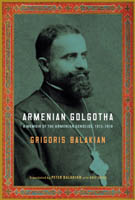
The other day was republished “Armenian Golgotha” by Grigoris Balakian, translated by Peter Balakian with Aris Sevag. “Armenian Golgotha” is the most dramatic and comprehensive eyewitness account of the first genocide of XX century.

The book was originally published in Armenian in two volumes as Armenian Golgotha: Episodes from the Armenian Martyrology from Berlin to Zor, 1914-1920 (Vienna: Mekhitarist Press, 1922) and Armenian Golgotha, Volume 2: Episodes from the Armenian Martyrology from Berlin to Der Zor (Paris: Imprimerie Araxes, 1959.)

On April 24, 1915, the priest Grigoris Balakian was arrested along with some 250 other intellectuals and leaders of Constantinople’s Armenian community. Is was the beginning of the Ottoman Turkish government’s systematic attempt to eliminate the Armenian people from Turkey; it was a campaign the continued through World War I and the fall of the Ottoman Empire, by which time more than a million Armenians had been annihilated and expunged from their historic homeland. For Grigoris Balakian, himself condemned, it was also the beginning of a four-year ordeal during which he would bear witness to a seemingly endless caravan of blood.

Balakian sees his countrymen sent in carts, on donkeys, or on foot to face certain death in the desert of northern Syria. Many would not even survive the journey, suffering starvation, disease, mutilation, and rape, among other tortures, before being slaughtered en route. In these pages, he brings to life the words and deeds of survivors, foreign witnesses, and Turkish officials involved in the massacre process, and also of those few brave, righteous Turks who, with some of their German allies working for the Baghdad Railway, resisted orders calling for the death of the Armenians. Miraculously, Balakian manages to escape, and his flight-through forest and Over Mountain, in disguise as a railroad worker and then as a German soldier-is a suspenseful, harrowing odyssey that makes possible his singular testimony.

Full of shrewd insights into the political, historical, and cultural context of the Armenian genocide-the template for the subsequent mass killings that have cast a shadow across the twentieth century and beyond-this memoir is destined to become a classic of survivor literature. Armenian Golgotha is sure to deepen our understanding of a catastrophic crime that the Turkish government, the Ottomans' successor, denies to this day.

GRIGORIS BALAKIAN, born in 1876, was one of the leading Armenian intellectuals of his generation. Educated in Germany and in the Ottoman Empire, he was ordained as a celibate priest in 1901 and served the Armenian Apostolic Church as an emissary to Europe, Russia in particular. He wrote several books, some of which were confiscated by the Turkish government in 1915 or subsequently lost. He later became bishop of the Armenian Apostolic Church in southern France. He died in Marseilles in 1934.

This annotation was taken from the book “Armenian Golgotha” by Grigoris Balakian.

Virtual Museum

International Conference

genocide
On April 20, 21, 2011, AGMI organizes an international conference "Armenian Genocide and Scandinavian response" dedicated to the 150th anniversary of Fridtjof Nansen.

Temporary Exhibition

exhibition
"ARMENIAN GENOCIDE AND SCANDINAVIAN RESPONSE"

Remember

remember
Haykazn Mihrdat was born in 1864 in Constantinople (Ottoman Empire), social-political figure, national deputy, president of the “Aharonyan akumb” (Aharonyan club) in Peshiqtash. He was a victim of the Armenian genocide.

Lemkin scholarship   new

Lemkin

Events of AGMI

November 10, 2011On November 9, 2011, the granddaughter of Fridtjof Nansen Marit Greve, with the Norwegian delegation, visited Tsitsernakaberd Memorial Complex ...

November 10, 2011On November 7, 2011, Asya Darbinyan, a graduate research fellow at the Armenian Genocide Museum-Institute, recently spent four days at the Armenian Research Center conducting research for her dissertation on Near East Relief orphanages ...

November 9, 2011On November 6, 2011, Grand Duchess Maria Vladimirovna Head of the Russian Imperial House visited Tsitsernakaberd Memorial Complex, put flowers at the eternal fire and honored the memory of the innocent victims with a minute of silence ...

October 25, 2011On October 25, 2011, the newly appointed U.S. Ambassador to Armenia John A. Heffern accompanied by his spouse Mrs. Libby Dowling Heffern, visited ...

October 13, 2011 On October 13, 2011, Secretary General of Interpol Ronald Noble visited Tsitsernakaberd Memorial Complex and put flowers at the memorial of the Armenian Genocide victims ...

August 31, 2011 On August 30, 2011, the regular meeting of the MFA senior staff and the heads of the diplomatic missions started in the Conference Hall of the K. Demirjian Sports and Concert Complex ...

August 27, 2011 Dr. Hayk Demoyan, director of the Armenian Genocide Museum-Institute, has become a new member of the Genocide Education Project’s (GenEd) advisory board ...

July 11, 2011 Fanny Ardant, the world known French actress, who visited Yerevan in the framework of the 8th edition of “Golden Apricot” Yerevan International Film Festival, visited Tsitsernakaberd Memorial ...

June 30, 2011 Director of AGMI H.Demoyan and Deputy Director of AGMI S.Manukyan had a meeting with ambassador of RA in Russia Oleg Yesayan in Moscow. During the meeting the projects and cooperation ...

June 17, 2011 Minister of French Cooperation Henri de Raincourt visited Tsitsernakaberd Memorial Complex, within the framework of his official visit to Armenia on June 16-17, and put a wreath at the memorial of the Armenian Genocide victims ...

June 17, 2011 The delegation headed by President of Brest Regional Executive Committee in Belarus Konstantin Sumar visited Tsitsernakaberd Memorial Complex. Mr. Konstantin Sumar put a wreath at the memorial of the Armenian Genocide victims ...

June 10, 2011 Thomas O. Melia, Deputy Assistant Secretary of USA, Bureau of Democracy, Human Rights, and Labor visited Tsitsernakaberd Memorial Complex, put flowers at the eternal fire ...

June 09, 2011 Dr. Ara Sanjian, the Associate Professor in Armenian and Middle Eastern History from University of Michigan - Dearborn had a meeting in the Armenian Genocide Museum & Institute with the staff of AGMI ...

June 01, 2011 The deputy-director of AGMI Suren Manukyan participated on conference dedicated to 150th anniversary of Fridtjof Nansens held in a city of Kharkiv, Ukraine ...

RA, Yerevan 0028
Memorial Complex of Tsitsernakaberd
Tel.: (374 10) 39 09 81
Fax: (374 10) 39 10 41
    2007-2011 © Armenian Genocide Museum-Institute     e-mail : info@genocide-museum.am