18.04.2009
“If you Americans begin to distribute food and clothing among them [Armenians], they will then think that they have powerful friends in the United States…”
Ottoman Empire War Minister Enver Pasha to US ambassador Henry Morgentau
From Ambassador Moregntau’s story
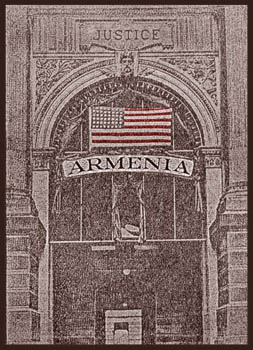 The entrance of the mayor’s
office
in Philadelphia, December 11-13, 1915
The current turmoil within Turkey’s politics renders this an excellent opportunity to ask whether the recognition of the Armenian genocide at the hands of Ottoman government is important simply for the sake of establishing historical justice or proving a series of events that establish historical facts. Neither US House of Representatives nor Senate should believe any harm could befall the US-Turkish strategic partnership or even escalate Armenian-Turkish relations to a much-anticipated detente in the future. The very problem lies within the representation and interpretation of the issue. Wrong assumptions often result in wrong perceptions. And in this world, perception is reality.
But being of sound mind and in order for us not to get caught up in trivial assumption and perceptions we should stop and find out who actually benefits from the recognition and condemnation of the Armenian Genocide? The answer is a surprising one: The American people and their memory. Unfortunately, the topic of the Armenian Genocide and its consequences are not taught in most US public schools and Universities. Nevertheless, every American citizen should know that his or her country became a champion in world history. Americans provided humanitarian assistance and very necessary food aide for all those suffering Christians: i.e., Assyrians, Greeks and most of all Armenians who suffered the ravages of WWI and the genocidal policies of the Turkish government.
“They Shall Not Perish” was the slogan at the top of an American Near East Relief Committee (founded in 1915) humanitarian poster issued after WWI. Many such posters were distributed to educate Americans about the dire situation in the Near East. America did her best, and many did not have to perish as a result of the massive efforts undertaken. There has been no precedent in the history of mankind displaying the size and volume of the colossal assistance the US government and American people provided for the Armenian people. Another slogan, the “Starving Armenians” seemingly pejorative labeling at first blush, is one of the many catch phrases used during the humanitarian activities which saved the lives of hundred thousands Armenians in the Middle East, Europe and Caucasus.
United States expressed its solidarity with the doomed Armenian people through human bravery. Clara Barton crossed the Atlantic Ocean and extended a compassionate American hand to the Armenians, shortly after Sultan Abdul Hamid massacred 300,000 people (1894-1896). She became the symbol of bravery and heroism upon which so many American missionaries and diplomats have come to rely on and know. This was the first, but certainly not the last American response to the barrage of Turkish atrocities that followed.
The attempted ‘Final Solution’ of the Armenians in the Ottoman Empire resulted also in the loss of dozens of American lives. These people were missionaries and diplomats who, despite fear and death threats, visited Armenia to help those they could reach. America allowed the Armenian people a rebirth from the ashes of death through the thousands of orphans saved and hundreds of orphanages set up to house these children. This is exactly the sort of knowledge every American must be proud of, mutually exclusive of his or her ethnic background.
Ninety years ago the US Congress also adopted a historical resolution to establish American Near East Relief, through which the US supplied humanitarian support to ease the suffering of Armenians, Greeks and other Near Eastern national. Blue stars of the NER soon covered the map of Eurasia to indicate locations where victims of genocide were becoming success stories of survival.
As a result of these tremendous efforts, Armenians who survived their ordeal were grateful and indebted to the Americans. They decided to reciprocate as best they could for good old American generosity and compassion. Thousands of Armenian who survived the genocide and found refuge under the American shield decided to serve their new homeland and embrace its values. Soon many Armenian-Americans, for generations to come would establish themselves as successful businessmen, doctors, engineers, lawyers and scholars, contributing to the American dream.
Armenians also fought and gave their lives for their new American homeland. Starting from the US Civil War, Armenian military men become part of American military service and duty. They also fought in the Spanish-American War, WWI, WWII, Korea, Vietnam and now also serve the in the modern US Army. During WWII, longing for their native villages and towns they were forcibly removed by the Turks, U.S. Armenian-American pilots painted the names of these locations on the fuselage of their Mustangs and Corsairs, gelling their memories with those of their new American experiences and becoming intertwined in the American military brotherhood. Among them was Ernest Dervishyan, who received the Congressional Medal of Honor. He and hundreds of other Armenian-Americans, from Generals to Infantry men, gave their lives to achieve American victories in Normandy, Okinawa, Sicily and other war theatres of WWII.
These are the stories of our united American and Armenian tragedies and glories, our united experiences and memories. In acknowledging the historical fact of the Armenian Genocide as a crime against humanity and civilization, the US government will also boldly affirm American history and memory, a huge portion of which in the Armenian story is about compassion, generous support and humanism. These are universal characteristics which not only unite Americans and Armenians but also resonant with every human being, who understands and values human dignity and the universal right to exist in this world, whether in Darfur, Sarajevo or elsewhere.
Ninety years ago, Aurora Mardikanian, an Armenian orphan who survived the genocide and suffered all possible inhuman treatment, appeared on American soil to “scream” about what happened to her nation. Through a silent movie she made, Aurora was quick to point out how America heard her suffering and responded. In fact, her movie was the first ever movie made about genocide. She starred in the film to show the world what kind of injustices the Armenian people suffered at the hands of the Ottoman Turks. This ‘silent scream’ echoed in the hearts and mind of thousand Americans, who were able to contribute for the sake of humanity.
Truly what is important for the US, in my opinion, is that its own personal history that must be remembered and respected, and not contextualized in a banal cliché of ‘strategic partnerships’ between countries. Even the refusal of former US presidents to label the Armenian atrocities as ‘genocide’ never turned supposed Turkish “allies” pro-American. Instead, the dynamics of the recent years prove that the majority of Turkish society are (and continue to grow) anti-American-mutually exclusive of the Armenian genocide issue.
This game of Genocide denial, initiated by the Ankara imposes also a denial of American memory and humanity. That’s why we have to unite our effort to fight back any evidence of corrupted scholarship and paid denial. Otherwise we are condemned to suffer new genocides and crimes against humanity giving new chances for future perpetrators and denialists.