07.07.2009
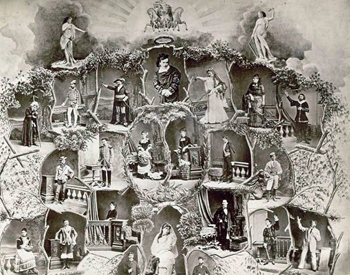
Historic evidence shows the establishment and the first 50 years of the development of the Turkish theater are strongly connected with the activity of Ottoman Armenians. The proof is that Armenians and Greeks were the first to bring any innovations from Europe to the Ottoman Empire. The 1850s are considered for Ottoman Armenians as the period of cultural revival. Armenian schools, publishing and media, sciences and literatures all experienced an awakening following the innovation and modernization in the important centers of the Armenian culture, such as Constantinople and Smyrna.
At the same time, numerous young Armenians graduated from the famous European universities. They imported many new ideas and innovations from Europe. Among these innovations, was theater; Armenian welcomed it with great enthusiasm, especially by Armenians from Constantinople.
In 1859, in Bera, a district of Constantinople, Mr. Srapion Hekimian performed plays in the Armenian colleges and within a short time; he transferred the theater department from the collage halls to professional scene, establishing the first Western Armenian professional theater, known as the “Eastern Theater.” Although the “Eastern Theater” did not survive long, it managed to earn great achievements. The best Ottoman Armenian actors, such as Ekshian, Fasouliajian, Mnakian, Penklian, Triants, Ajemian, Arousyak, etc. appeared as professional actors in this theater.
Hakob Vardovian was also among those, who appeared in a few performances of Hekimian’s “Eastern Theater” as an amateur actor. Although he was not very talented, he later became the founder and promoter for Ottoman Turkish Theater. After the “Eastern Theater” closed down, Vardovian, along with a few young Armenian actors, organized a group who rented out Kedik Pasha’s circus and turned it into a theater in 1867. In a short span, Vardovian’s theater gained a great fame. And organizing mobile performances in the suburbs of Constantinople such as Skyutar (Uskudar), Gatygyukh (Kadikoy), Bera he managed to attract the attention and appreciation of people of Constantinople.
No one had tried to present plays in Turkish before the establishment of Vardovian’s “Ottoman Theater.” In 1869 he brought to stage the play “Caesar Borcia” in Turkish for the first time, at the Kedik Pasha Theater. There were two important reasons why he did so: first, the acting troupe would appear with the financial support of Turkish authorities; second, it would make a connection between the Turkish audience and theater, which in turn could guarantee an additional source for quick income. His two expectations came true and only Vardovian’s theater received a permission in Constantinople to be named as the “Ottoman Theater”. This achievement lasted for about 10 years during the theater’s existence. Vardovian’s theater performances always enjoyed a sold out hall which enabled him to grant high honorariums to his actors.
“Ottoman Theater” experienced such great success in the 1870s that it was able to compete with the best European theaters of that time. In 1876 when the late British Prime Minister Salisbury visited Constantinople on a special diplomatic mission, Vardovian’s acting troupe were presenting three plays at the Kedik Pasha’s Theater. Imperial nobilities and the British diplomat, along with his companions were present at all these three performances, indicating the important role this theater played in the capital city of the Ottoman Empire.
However, the “Vardovian Acting Troupe” of the newly renamed “Ottoman Theater” was dissolved after Sultan Abdul Hamid ordered the theater razed within a day. The reason for the destruction was based in Ahmet Midhadi’s “Cherkez Eozdens” play, which had caused great unrest among Sultan’s Cherkez bodyguards. To reestablish order and peace in the palace, Abdul Hamid simply ordered the theater demolished and promptly dissolved the acting troupe.
The improvements of the Turkish classic dramaturgy coincided with the activities of the “Ottoman Theater” established by the efforts of Vardovian. In other words, in the primary establishment stages, the translations of plays were presented. Later, Vardovian demanded and encouraged new plays from Turkish writers who began to write plays for this theater. In a short time, the number of plays increased to 100. Among these were all the works of the Turkish classic writers of the time such as Namek Kemal’s “Vatan or Silistra”, “The Poor Child”, "Akef Bey" and “Gyulnihal”, Ahmet Midhad’s “Cherkez Eozdens”, Shemseddin Sami’s “Besa”, Abdul Hak Hamid’s “The Indian Woman”, Abu Zia Tefik’s “The Accidental Death”, Rijaizadeh Ekrami’s “Vusluat”, Manastrel Mehmet Rifati’s works, more than 20 transformations and a series of unique works by Hassan Bedreddin, a few of Ahmet Vefik Pasha’s translations of Moliere, Ali Heydar Bey’s “Arsas” and other works.
Rudolf Talaso, who was a contemporary to Vardovian and wrote the history of Turkish theater, considers the 10-year activities of the “Ottoman Theater” as its heyday. Ahmet Fehim (1856-1930) was the first Turkish actor and has been considered one of the most outstanding faces of Turkish drama for 50 years, both as an actor and as a director and also as the head of the actors group. He took his first stage efforts in 1876 in Hakob Vardovian’s “Ottoman Theater.” His first teacher was Tovmas Fasoulajian. After the Vardovian’s theater was dissolved, Fehim went to Bursa along with Fasoulajian and continued his career as an actor among Armenian art lovers. In his diaries, he later evaluates the role and mission of Vardovian’s theater as very high, considering it the first Turkish professional theater.
Metin And, another historian of Turkish theater, referring to Vardovian’s theater, notes that Vardovian had established such quality professional theater, that nothing comparable in terms of professionalism was made even after the reestablishment of the Ottoman Constitution.
Therefore, Armenians played a tremendous role in the establishment and improvement of the Turkish theater and drama. This fact has been evaluated by Foreign, Armenian and Turkish theatre critics alike as well as historians.