17.08.2010
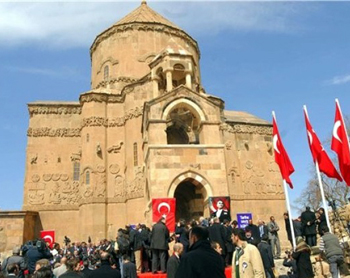
The second Akhtamar ceremony this time as a one-day religious ceremony is scheduled for September 19, 2010. It could be regarded as a state orchestrated show or more correctly a farce. Official Ankara generously allowed a religious performance for one day only on Sept. 19, 2010 and a cross will be placed on the dome of this 10th century Armenian temple located on the small island of Van lake.
We all remember March 2007 ceremony, when Turkey initiated the series of informational flows around the restoration of the Akhtamar church and launched a shameful tradition of turning Christian churches into museums with a purpose to earn money from expected tourist flows. The fate for the rest of Armenian and Greek Christian heritage in Turkey is if not to be destroyed fully then to be converted into a prison, a mosque, a bath, sporting hall, or a good stone material for construction work.
The opening ceremony of the Akhtamar Holy Cross temple after the restoration heavily was staffed with Turkish flags and portraits of Ataturk. It was not allowed to erect a cross on the dome of the Christian church, but the Turkish flags with a symbol of Islam were attached to the temple walls. Gagik Artsruni, the Armenian king of Vasuprakan-Van kingdom and his chief architect Manuil never expected that one day Turkish flags will be used as a decoration of the temple and Ataturks face will welcome all visitors. What about if next time Turkish government decides to restore an old Armenian bathhouse, for example in Ani capital?
The restoration of Christian monuments in Turkey is seems already turned a business being regarded as a lucrative place to earn money and at the same time to create positive image of multicultural and tolerant country, such as the small brother of Turkey, Republic of Azerbaijan practices heavily, especially after the destruction of the medieval Armenian cross-stones in Old Djugha cemetery in December 2005. The latter creates this image not without help of former and current Directors of UNESCO who visited Azerbaijan, a country practicing vandalism officially, four times within last three years.
Returning to Akhtamar issue one could say that it is in a chain of Turkish informational operations mostly targeting international audience for propagandistic purposes.
In 1974 UNESCO stated that after 1923, out of 913 Armenian historical monuments left in Eastern Turkey, 464 have vanished completely, 252 are in ruins, and 197 are in need of repair. Armenian architectural buildings are consistently being demolished using dynamite and are used as targets during Turkish military training exercises; the undamaged stones are used as construction materials. In some rural places, Armenian monasteries and churches serve as stables, stores, clubs and in one case, even as a prison. On many occasions the Turkish government converted the buildings of the Armenian churches into mosques.
This is of course an old data so the updated figures, for sure, will be more upsetting. The last signal from the Turkey on full destruction of the village church came in 2009, when a Turkish villager destroyed a survived Armenian church looking for hidden treasures.
Cultural genocide is a continuous process in Turkey. Modern era destructions of Christian heritage are vividly visible not only on the example of destruction of the Armenian Christian monuments, but also Greek monuments of Anatolia and Northern Cyprus occupied by Turkish armed forces. Nobody can browse he catalogue of all early Christian monuments desecrated on the occupied territories of Northern Cyprus without a horror. Destruction, desecration, conversion and smuggling…
One could ask why the decision makers and propagators of tolerance in Turkey were not so principle to restore and inaugurate another 10th century temple in Kars city. The temple of St. Apostles currently converted as a mosque. The attempt of Armenian pilgrims to burn candles outside of the Christian temple faced with an aggressive assault of locals who bit them up.
Last year an American couple showed me a manual for usage of metal detectors produced by Turkish company to discover treasures. It said that the best place to find gold and other treasures are Christian cemeteries and the fundaments of Christian churches. To their surprise I was not surprised while reading the Turkish text of instruction. The reason I explained my behavior is very simple: “welcome to Turkey, guys”.
Nobody could have any doubt that this metal detector’s instruction text in fact is a mirror of the Turkish state policy towards minorities and their cultural heritage. This policy symbolically represents itself as a huge metal detector, which detects not only Armenian gold hidden during deportations, but also metal crosses over the Christian temples.
by Hayk Demoyan